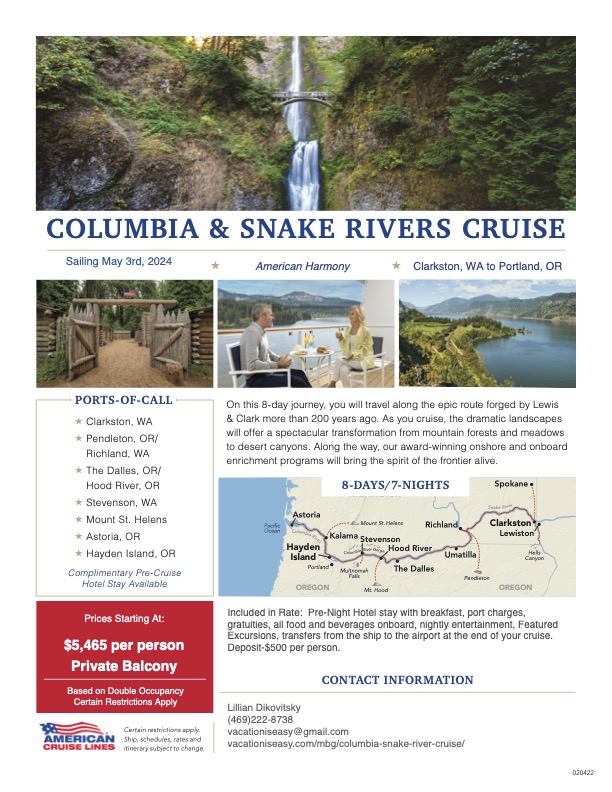
American Cruise Lines riverboats cruise the Columbia and Snake Rivers. These rives have served as a source of power, transportation, and commerce for many years. Ships used to struggle to navigate the rapid currents caused by the dramatic slopes of the rivers.
In 1933 the Works Era Project began work on Columbia and Snake Rivers. The Bonnevile Dam was completed under the Roosevelt administration in 1937. This was the first dam on the Columbia River and it created hydroelectric power for the power grid of the Pacific Northwest. Engineers installed locks to help level off the water flow. This worked like a staircase allowing vessels to rise or descend in elevation in order to navigate what were once treacherous waters.
Over the next 5o years, seven additional locks and dams were constructed along the Columbia and Snake Rivers. These rivers are a part of our nation’s “Marine Highway,” designated and managed by the U.S. Army Corps of Engineers.
If heading upstream, the ship enters the lock at the lower level. The gates and lower drains close, making the lock chamber watertight. The upper drains are then opened, allowing the water to enter the lock by gravity and raise the boat. Once the water level in the lock is the same as in the upstream portion of the canal, the upper gates are opened, and the boat continues its way.

For ships heading downstream, the ship enters the lock at the higher level. The upper gates and drains are closed to make the lock chamber watertight. The lower drains are then opened, allowing the water to flow out. When the water level is the same on both sides of the lower gates, they are opened, and the ship continues on its way.
American Cruise Lines riverboats on the Columbia & Snake Rivers encounter four locks on each river. Join Vacation Is Easy on this river cruise on the Columbia & Snake Rivers. Use this link for more information.